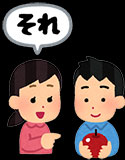
 In English, nouns often appear with small words called
articles, such as
a,
an, and
the.
Japanese usually does not use articles.
Instead, the meaning is understood from context, particles, or words such as
この,
その,
あの,
これ,
それ, and
あれ.
In English, nouns often appear with small words called
articles, such as
a,
an, and
the.
Japanese usually does not use articles.
Instead, the meaning is understood from context, particles, or words such as
この,
その,
あの,
これ,
それ, and
あれ.
In English, articles help identify a noun.
- a / an — one item, not specific
- the — a specific item
Examples:
a book / an apple / the book
Sometimes English nouns appear without an article. This is called the zero article. This usually happens when speaking about things in a general sense, or about things that cannot be counted individually.
- Birds fly.
- I like music.
Japanese nouns usually appear without articles.
犬がいる
— a dog is here
— the dog is here
The exact meaning depends on the situation.
Japanese often clarifies nouns using demonstratives, counters, or descriptive phrases.
- この本 — this book
- その犬 — that dog
- あの店 — that shop over there
- それです — that's it / that's the one
Japanese can also specify a noun using quantity.
I bought a book.
本を 一冊 買った。
Context also plays an important role.
本を買った
I bought a book
I bought the book
I bought books
These meanings are understood from the context of the conversation.
In everyday English, some nouns that are normally uncountable can become countable when referring to a serving.
- I drank beer. — general substance
- I drank a beer. — one glass or bottle of beer
In everyday conversation, words such as “glass of” are often omitted.
I drank a beer.
ビールを(一杯)飲んだ。
In some English exams in Japan, students may be expected to write “I drank beer,” because beer is usually taught as an uncountable noun.
So everyday English and school grammar do not always match perfectly.